Online Astrology Foundation Course
A structured, experiential introduction to astrology and birth-chart interpretation for beginners, refreshers and anyone wanting a thorough grounding in astrology. UK-based and open worldwide.
Enrolment is now open for 2027-2028 Foundation Course
The Kairos Foundation Course offers a thorough grounding in astrology, taking you from the fundamental structure of the birth chart — signs, planets, houses and aspects — through to the practical art of chart interpretation, planetary cycles, transits and secondary progressions.
Alongside a strong technical foundation, the course draws on mythology, story, image, music, mask and work with your own birth chart to bring the archetypal symbolism of astrology to life. The emphasis is not simply on learning what astrological symbols mean, but on discovering how they express themselves through our own lived experience.
The course has been completely restructured for 2027–28, with a wealth of newly recorded teaching material and weekly live tutorials providing an opportunity to engage directly with the teaching.
The Foundation Course now comprises 26 modules delivered in two parts, each of which can be booked independently, or together at a discounted rate.
Who is the Astrology Foundation Course for?
The Foundation Course is designed for people who want a thorough grounding in astrology, whether you are completely new to the subject or already have some knowledge and want to bring greater structure, depth and confidence to your understanding.
The emphasis is not simply on learning astrological techniques, but on developing a living relationship with astrology through your own birth chart, mythology, symbolism and direct experience.
The course offers a journey of profound self-understanding and personal transformation, with the focus being on a study of your own personal birth chart.
What people have said about Kairos Foundation courses…
“John Wadsworth’s foundation course is one of the most enjoyable courses I have taken. John’s clear love and deep knowledge of astrology, the night sky, mythology and history is profoundly articulated through his poetic and graceful teaching style. A true pleasure to learn to integrate this ancient science into every day life. I could not recommend this course more.” (Keri Lassalle)
"This foundation course has brought me so much more than I could have anticipated when I started this journey. I thank you all for the different ways you all embody astrology, because for me that is the most important of all.” (Kristien de Winter)
"I enrolled in the Kairos School because I sensed a supportive environment in which to deepen my understanding of astrology. The course exceeded my expectations, and I can wholeheartedly recommend the Foundation Course to everyone interested in learning astrology, or sharpening and honing their skills." (Franklin LaVoie)
"John is a soulful, thoughtful, knowledgeable, enthusiastic teacher of astrology. The lessons are varied in style which keeps the interest there and I can't recommend John and the support team (Tamsin and Gillian) enough. I have enjoyed every moment of this celestial and inner journey." (Joumana Mobarak)
Here’s a teaser trailer from one of the lessons.
Kairos Online Astrology Foundation Course Structure
Part One: The Living Experience of Astrology
The Four Layers of the Birth Chart
12 modules: 5 April – 13 July 2027
Part One offers a comprehensive introduction to the archetypal structure of the birth chart.
Beginning with the history and philosophical foundations of astrology, we will explore the zodiac signs, four elements and three crosses, before turning to the planetary archetypes, the twelve houses and major aspects. The course concludes with an introduction to the outer planets and the Moon's nodes.
This first part stands independently as a substantial introduction to astrology, and provides the necessary grounding for students wishing to continue into Part Two.
This first part of the course includes:
Approximately 24–26 hours of video teaching across 12 modules.
12 live, two-hour tutorials on Zoom, Tuesdays from 6pm–8pm UK time.
Comprehensive course notes, weekly self-study assignments and additional resources.
An end-of-course assignment with personalised tutor feedback.
The first video module is released on Monday 5 April, with the first live tutorial on Tuesday 13 April. There is a half-term break in May, and the final tutorial takes place on Tuesday 13th July.
Part Two: The Dynamics of Birth Chart Interpretation
The Art and Practice of Astrological Work
14 modules: 4 October 2027 – 4 April 2028
Building on the material introduced in Part One, we move more deeply into the art and practice of birth chart interpretation.
The course develops the practical skills of chart interpretation through house craft, the assessment of planetary strength, retrograde motion, minor aspects and the relationships between different elements of the birth chart.
You will also learn to work with an ephemeris, and gain a deep understanding of planetary cycles, transits & secondary progressions as ways of understanding the unfolding patterns of a life.
Part Two comprises fourteen modules, delivered in two seven-week blocks with a break over Christmas.
This second part of the foundation course includes:
14 modules of comprehensive video teaching, released weekly across two seven-week blocks, with a break over Christmas.
14 live, two-hour tutorials on Zoom (28 hours in total), developing the practical skills of birth chart interpretation and synthesis.
Comprehensive course notes, weekly self-study assignments and additional learning resources.
An end-of-course assignment with personalised tutor feedback.
Students continue to work with their own birth charts, supported by weekly live tutorials, self-study exercises and an assessed assignment with personalised feedback.
How the Course Works
You can choose to take just Part One of the course, and then decide later if you want to continue on to Part Two, or you can sign up for the whole course, which includes Part One and Part Two.
Each module includes specially recorded video teaching, accompanied by comprehensive downloadable notes, self-study assignments and additional learning resources.
A new module is released each week, allowing you to engage with the material in your own time before joining the live tutorial.
The weekly two-hour tutorials provide an opportunity to review the teaching, address your questions and apply what we are learning to actual birth charts, including those of participating students.
The course is supported by two deeply knowledgeable astrologers and teachers: Melissa Gledhill and Tamsin St George, who provide additional teaching support and are involved in assessing the end-of-course assignments.
Students should be prepared to dedicate a minimum of six hours per week to their studies, including the recorded teaching, live tutorials, reading and self-study assignments.
Students enrolling for both parts will retain access to the online classroom and course materials until 31 Aug 2028.
Course Fees and Enrolment
PART ONE
The Living Experience of Astrology
12 Modules
5th April – 13th July 2027
£495 - special early bird
Special Early Bird price - if paid in full by 15 Dec 2027
£595 - Standard Fee
This can be pay by instalments
£195 + 4 × £100 instalments
PART TWO
The Dynamics of Birth Chart Interpretation
14 Modules
4th October 2027 - 4th April 2028
£695 - Standard Fee
It is highly recommended to take the whole course, but if you want to move straight to part two of the course, you can apply below.
PARTS ONE & TWO
The Foundation Course in Astrological Studies
26 Modules
5th April 2027 – 4th April 2028
£945 - special early bird
Special Early Bird price - if paid in full by 15 Dec 2027
£1095 -Standard Fee
This can be pay by instalments
£195 + 9 × £100 instalments
What Makes This Online Astrology Course Different?
What if learning astrology wasn't really about memorising what all the planets and signs mean? What if it was about learning to see differently?
I first came to astrology through an experience of the night sky that completely changed the way I saw the world. And from there, astrology opened into something much larger for me — a living language of relationship between psyche and cosmos, myth and experience, the movements of the heavens and the patterns of our own lives.
And yes, on this Foundation Course you'll learn the structure. The course is built around a very strong structure. You’ll learn about the planets, the signs, the houses, the aspects. You'll learn how to read a birth chart, how planetary cycles work, and eventually how to understand transits and progressions. But it's important that those things don't just remain abstract symbols on a page. We want them to come alive. Because Mars isn't merely a symbol in your chart. Mars is something you know. It’s the part of you that fights, that acts, that cuts through, that takes a risk. It’s the part of you that gets angry, finds courage. And we don't experience Venus through a list of keywords we associate with her. We experience Venus in the way we love, in what we value, in what draws us, in what we find beautiful.
And gradually the birth chart begins to feel less like a diagram, and more like a kind of theatre of the psyche, with different characters, different voices, different desires. All seeking expression through one human life. That's why the course is experiential. We work with myth, story, image, music, mask and active imagination. And above all, we work with your own birth chart. Because the best place to begin learning astrology is with the mystery of your own life. It’s not enough just to ask: “What does this symbol mean?” But rather to pose the question: “How does this live in me?” “Where do I recognise this in my own character?”, “What is this pattern asking of me?”
If that sounds like the astrology you want to learn, register your interest in the new Kairos Foundation Course. Perhaps this is your moment to begin.
-
We begin by tracing the origins of astrology and its place within the history of human thought. From the ancient world to the emergence of modern psychological astrology, we explore the philosophical foundations of the astrological tradition and introduce the birth chart as a symbolic map of the heavens, reflecting the archetypal patterns of a human life.
Topics include:
A brief history of astrology, from Mesopotamia and ancient Egypt to the present day.
The philosophical foundations of astrology and the relationship between cosmos and psyche.
Introducing the archetypal language of astrology.
An introduction to the planetary archetypes.
The four fundamental layers of the birth chart: signs, planets, houses and aspects.
Teaching Videos Released: Monday 5th Apr 2027
Live Class: Tuesday 13th Apr 2027: 6pm - 8pm (UK time)
-
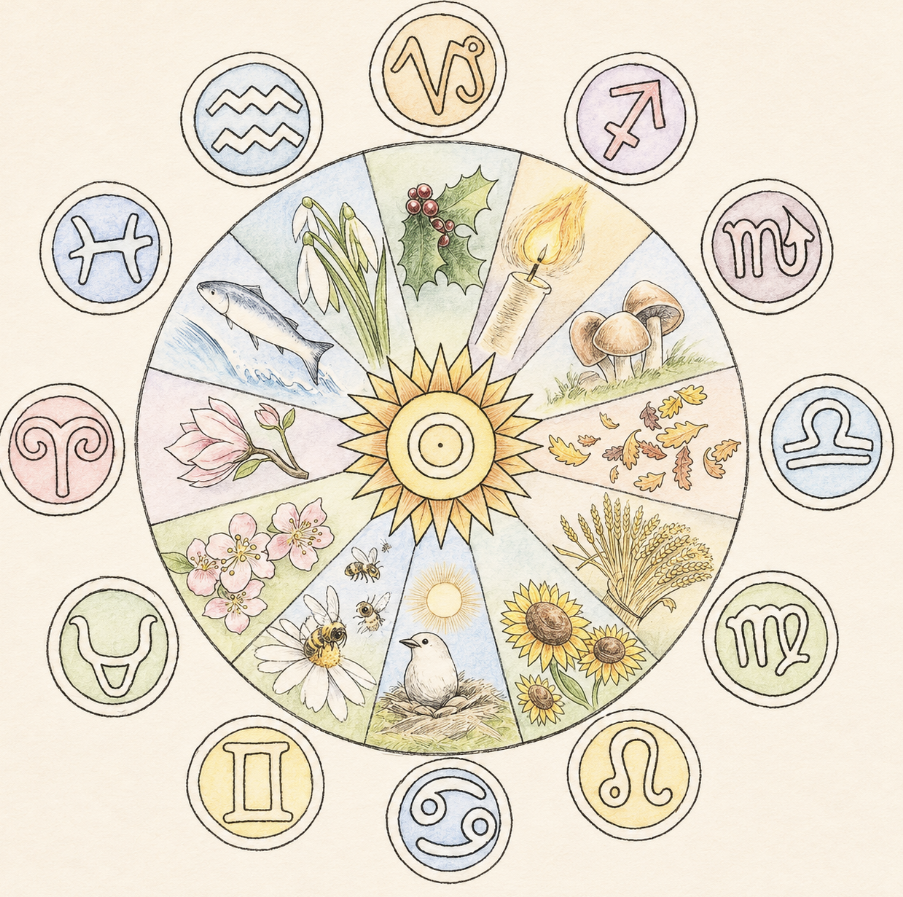
The zodiac is a great wheel of life, rooted in the turning of the seasons and the cyclical rhythms of nature. We journey through the twelve signs, encountering their mythology, imagery and archetypal significance, and discovering how each sign expresses a particular quality of human experience, with its own gifts, challenges and possibilities for transformation.
Topics include:
The history and origins of the zodiac.
A journey through the twelve zodiac signs and their archetypal qualities.
The twelve zodiacal glyphs and their symbolism.
Seasonal festivals, mythology and ceremonial correspondences.
The relationship between the zodiac signs and the human body.
Planetary rulerships, and the light and shadow of each sign.
Teaching Videos Released: Monday 12th Apr 2027
Live Class: Tuesday 20th Apr 2027: 6pm–8pm (UK time)
-
Fire, Earth, Air and Water are fundamental principles of the natural world and of our own experience. Each element describes a particular way of being, perceiving and responding to life. Through the elements, we begin to recognise the different temperaments at work within ourselves, and how their balance or imbalance shapes our individual nature.
Topics include:
The history and philosophy of the four elements and traditional temperament theory.
The distinctive qualities of Fire, Earth, Air and Water.
The relationship between the elements and the twelve zodiac signs.
Understanding the elemental balance within your own birth chart.
Identifying your natural strengths and the elements that may need greater attention.
Teaching Videos Released: Monday 19th Apr 2027
Live Class: Tuesday 27th Apr 2027: 6pm–8pm (UK time)
-
The three crosses - cardinal, fixed & mutable - describe three fundamental orientations towards life: the impulse to initiate, the capacity to sustain, and the willingness to adapt and change. Together with the four elements, they provide the underlying architecture of the twelve zodiac signs, revealing different ways in which we engage with the world and participate in the unfolding of life.
Topics include:
The philosophical and spiritual significance of the three crosses.
The Cardinal Cross: initiation, action and new beginnings.
The Fixed Cross: stability, continuity and the preservation of form.
The Mutable Cross: adaptation, transition and transformation.
Understanding each zodiac sign through its position within the crosses.
Assessing the balance of Cardinal, Fixed and Mutable qualities in your own birth chart.
Teaching Videos Released: Monday 26th Apr 2027
Live Class: Tuesday 4th May 2027: 6pm–8pm (UK time)
-
The Sun and Moon are the two great luminaries of the birth chart, each illuminating a different dimension of human experience. The Sun speaks to our developing sense of individuality and creative purpose, while the Moon connects us to the instinctual, emotional and imaginal life. Their relationship reveals a fundamental polarity within the human psyche.
Topics include:
The solar archetype: individuality, consciousness and creative expression.
The lunar archetype: instinct, memory, belonging and the emotional life.
The mythology and symbolism of the Sun and Moon.
The Sun through the twelve zodiac signs.
The Moon through the twelve zodiac signs.
The relationship and polarity between our solar and lunar natures.
Teaching Videos Released: Monday 10th May 2027
Live Class: Tuesday 18th May 2027: 6pm–8pm (UK time)
-
Mercury, Venus and Mars bring us into the more personal dimensions of planetary experience. Through these three archetypes, we encounter our capacity for thought, communication, relationship, desire and action. Drawing on mythology and astrological theatre, we begin to recognise these planetary figures as living presences within our own psychological experience.
Topics include:
Mercury: thought, communication, interpretation and the connecting principle.
Venus: love, beauty, attraction and the experience of relationship.
Mars: desire, assertion, courage and the capacity to act.
The mythology and archetypal significance of the three personal planets.
Mercury, Venus and Mars through the zodiac signs.
The Venus–Mars polarity and the relationship between attraction and desire.
Mercury and the hermeneutic art of interpretation.
Teaching Video Released: Monday 17th May 2027
Live Class: Tuesday 25th May 2027: 6pm–8pm (UK time)
-
Jupiter and Saturn represent two powerful, contrasting principles within the individual psyche and the wider social world. Jupiter seeks growth, possibility and meaning, while Saturn establishes structure, responsibility and the necessary limits of earthly existence. Together, they illuminate the relationship between freedom and necessity, aspiration and reality.
Topics include:
Jupiter: growth, wisdom, opportunity and the search for meaning.
Saturn: boundaries, discipline, responsibility and the experience of limitation.
The mythology and archetypal significance of Jupiter and Saturn.
The Jupiter–Saturn polarity and their complementary functions.
The roles of Jupiter and Saturn within society and its institutions.
Understanding Jupiterian and Saturnian patterns within the family system.
Teaching Video Released: Monday 24th May 2027
Live Class: Tuesday 1st June 2027: 6pm–8pm (UK time)
-
The twelve houses bring the planetary archetypes into the living landscape of human experience. Rooted in the turning of the Earth beneath the heavens, they describe the different areas of life in which our personal stories unfold. We explore the geography of the birth chart, its four angles, hemispheres and axes, and the developmental themes associated with each house.
Topics include:
The astronomical foundations of the twelve houses and their astrological significance.
The Ascendant and Descendant: the horizon of the birth chart.
The Midheaven and IC: the vertical axis of the chart.
The four angles and their significance.
The hemispheres and quadrants of the birth chart.
The six house axes and their complementary themes.
The developmental journey through the twelve houses.
Applying the houses to the interpretation of personal birth charts.
Teaching Video Released: Monday 31st May 2027
Live Class: Tuesday 8th June 2027: 6pm–8pm (UK time)
-
The aspects describe the relationships between planets within the birth chart. Through the geometry of the circle, we encounter the different ways in which planetary archetypes interact — sometimes harmoniously, sometimes through tension or conflict. We begin to recognise how these relationships contribute to the inner dynamics of a person's experience.
Topics include:
The geometry of the zodiac and the division of the circle.
The five classical aspects: conjunction, opposition, trine, square and sextile.
The symbolic and experiential qualities of each aspect.
Understanding orbs and planetary relationships.
The Ptolemaic order of rulership and the traditional qualities of the aspects.
Working with chart examples to recognise how aspects express themselves in lived experience.
Teaching Video Released: Monday 14th June 2027
Live Class: Tuesday 22nd June 2027: 6pm–8pm (UK time)
-
With Uranus and Neptune, we encounter planetary archetypes that take us beyond the familiar boundaries of personal experience. Uranus brings themes of awakening, disruption and liberation, while Neptune opens us to the world of imagination, longing and transcendence. Through mythology and astrological theatre, we explore how these forces find expression in individual lives and the wider collective.
Topics include:
The mythology and archetypal significance of Uranus.
Uranus as an agent of awakening, innovation and change.
The mythology and archetypal significance of Neptune.
Neptune and the realms of imagination, idealism and dissolution.
Meeting Uranus and Neptune through astrological theatre.
Understanding the sign and house placements of Uranus and Neptune in the birth chart.
Teaching Video Released: Monday 21st June 2027
Live Class: Tuesday 29th June 2027: 6pm–8pm (UK time)
-
Pluto takes us into the deeper, often hidden dimensions of the human psyche. Drawing on the mythology of the underworld, we encounter themes of power, loss, death and renewal, and the processes through which profound transformation becomes possible through a a deep encounter with the life of the Soul. We consider Pluto's place within the birth chart and the ways in which its archetypal themes may unfold through lived experience.
Topics include:
The mythology of Pluto and the underworld.
Pluto's archetypal associations with power, loss and transformation.
The relationship between Pluto and the psychological shadow.
The themes of death, renewal and regeneration.
Encountering the Pluto archetype through astrological theatre.
Understanding Pluto's sign and house placements in the birth chart.
Teaching Video Released: Monday 28th June 2027
Live Class: Tuesday 6th June 2027: 6pm–8pm (UK time)
-
We conclude Part One of the course with the Moon's nodes, where the lunar orbit intersects the path of the Sun, and how the prediction of becomes possible. The nodal axis introduces a further dimension to the birth chart, opening questions of destiny, inheritance, familiar patterns and the movement towards new possibilities. We explore both the astronomical and symbolic significance of the nodes, including their karmic interpretations.
Topics include:
The astronomical nature of the Moon's nodes.
The relationship between the lunar nodes and solar and lunar eclipses.
The North Node and its association with growth and development.
The South Node and its association with memory, inheritance and familiar patterns.
The karmic perspective on the nodal axis.
The bendings of the nodes and the concept of the skipped step.
The twelve nodal axes, illustrated through birth chart examples.
Identifying eclipses within the birth chart.
Teaching Video Released: Monday 5th July 2027
Live Class: Tuesday 13th July 2027: 6pm–8pm (UK time)
Foundation Course 2027-28
Part One: The Living Experience of Astrology
5th April - 13th July 2027
Part One comprises 12 modules.
It offers a comprehensive introduction to the archetypal structure of the birth chart.
Beginning with the history and philosophical foundations of astrology, we will explore the zodiac signs, four elements and three crosses, before turning to the planetary archetypes, the twelve houses and major aspects. The course concludes with an introduction to the outer planets and the Moon's nodes.
Click on the + symbol next to the lesson title to find out more about the content, and to see the release dates and live tutorial dates for each class.
Part Two:
The Dynamics of Birth Chart Interpretation
4th Oct 2027 - 4th Apr 2028
Part Two comprises 14 modules
Building on the material introduced in Part One, we move more deeply into the art and practice of birth chart interpretation.
The course develops the practical skills of chart interpretation through house craft, the assessment of planetary strength, retrograde motion, minor aspects and the relationships between different elements of the birth chart.
We will also learn to work with an ephemeris and follow the changing planetary cycles, before introducing transits and secondary progressions as ways of understanding the unfolding patterns of a life.
Click on the + symbol next to the lesson title to find out more about the content, and to see the release dates and live tutorial dates for each class.
-
Building on our introduction to the twelve houses in Part One, we explore the astronomical foundations of the house system, examining how the houses are formed through the diurnal motion of the heavens. We consider the power and significance of the four angles of the birth chart, and explore the distinctive qualities of the angular, succedent and cadent houses. Through this deeper understanding of the structure and symbolism of the houses, we develop a richer appreciation of how planetary energies find expression within the different spheres of human experience.
Topics include:
An introduction to the different house systems used in astrology.
Revisiting the themes and developmental significance of the twelve houses.
The Angular, Succedent and Cadent houses and their distinctive qualities.
The significance of angularity and planetary placement within the chart.
Understanding how planets express themselves through the houses.
Practical interpretation of planets in houses using birth chart examples.
Teaching Videos Released: Monday 4th October 2027
Live Tutorial: Tuesday 12th October 2027, 6pm–8pm (UK time)
-
The relationships between planets, signs and houses reveal an intricate web of connections within the birth chart. Through the principles of house rulership and dispositorship, we discover how different areas of life communicate with one another, and how particular planets may assume a central role within the chart. This provides an important foundation for developing a more integrated approach to chart interpretation.
Topics include:
Revisiting planetary rulerships and understanding house cusps.
Identifying the planetary ruler of each house.
The distinction between a planet occupying a house and the planet ruling that house — the landlord and tenant principle.
The Ascendant ruler, or Lord of the Chart, and its significance.
Understanding intercepted signs and planets.
Dispositorship, chains of rulership and the final dispositor.
Mutual reception and its interpretative significance.
Teaching Video Released: Monday 11th October 2027
Live Tutorial: Tuesday 19th October 2027, 6pm–8pm (UK time)
-
Not all planets operate with equal ease or prominence within the birth chart. In this module, we explore the traditional principles of planetary dignity and debility, alongside other factors that influence how a planet expresses itself. We learn to assess planetary strength, recognising that a planet's difficulties and challenges may be just as revealing as its apparent strengths.
Topics include:
Essential dignity: planetary rulership and exaltation.
Essential debility: detriment and fall.
The significance of angularity and house placement in assessing planetary strength.
Dispositorship, mutual reception and the final dispositor.
The influence of intercepted signs and retrograde motion.
The significance of challenging aspects, particularly those involving Saturn and the outer planets.
Bringing these different considerations together when interpreting a planet's role within the chart.
Teaching Video Released: Monday 18th October 2027
Live Tutorial: Tuesday 2nd November 2027, 6pm–8pm (UK time)
-
Moving beyond the five major aspects introduced in Part One, we explore the subtler geometries of the birth chart and the complex patterns formed through planetary relationships. These configurations reveal underlying tensions, creative possibilities and recurring psychological themes, helping us to recognise how different planetary archetypes participate in the larger dynamics of the chart.
Topics include:
Revisiting the different qualities of red, blue and green aspects.
The semi-sextile (30°) and quincunx or inconjunct (150°).
The significance of overall chart shapes and planetary distribution.
The Grand Trine, Minor Grand Trine, T-Square and Grand Cross.
The Kite, Mystic Rectangle and Yod configurations.
The Great Learning Triangle and its developmental significance.
An introduction to special harmonic aspects and their symbolism.
Identifying and interpreting aspect patterns in birth charts.
Teaching Video Released: Monday 1st November 2027
Live Tutorial: Tuesday 9th November 2027, 6pm–8pm (UK time)
-
Chiron introduces us to the archetype of the wounded healer, opening a profound dimension of psychological and spiritual understanding within the birth chart - astrology as a healing modality. Drawing on the mythology of Chiron, and its astrological significance, we explore the relationship between woundedness, vulnerability, healing and the emergence of wisdom through our lived experience.
Topics include:
The mythology of Chiron and the archetype of the wounded healer.
The discovery of Chiron and its relationship to shifts in the cultural zeitgeist.
The psychological and spiritual significance of woundedness.
The relationship between vulnerability, healing and the development of wisdom.
Understanding Chiron's placement by sign and house.
Interpreting planetary aspects to Chiron within the birth chart.
Recognising Chiron's themes through personal reflection and chart examples.
Teaching Video Released: Monday 8th November 2027
Live Tutorial: Tuesday 23rd November 2027, 6pm–8pm (UK time)
-
The changing phases of the Moon reveal one of the most fundamental rhythms of life: the eternal cycle of emergence, growth, fulfilment, decline and renewal. In this module, we explore the eight phases of the lunation cycle and their significance within the birth chart, discovering how the relationship between the Sun and Moon illuminates our underlying orientation towards life.
Topics include:
Understanding the relationship between the Sun and Moon through the lunation cycle.
The eight phases of the Moon and their archetypal significance.
The symbolic themes of emergence, growth, culmination, release and renewal.
How to calculate and identify the lunar phase at birth.
The psychological and developmental qualities associated with each phase.
Interpreting the natal Moon phase through personal birth chart examples.
Teaching Video Released: Monday 22nd November 2027
Live Tutorial: Tuesday 30th November 2027, 6pm–8pm (UK time)
-
The birth chart represents a single moment within the continually unfolding movement of the heavens. In this module, we begin to follow that movement through the ephemeris, learning how to track planetary positions over time, and and recognise the rhythms of planetary motion. As part of that, we explore the phenomenon of retrograde motion, both its astronomical and astrological significance. This class lays the foundations for our subsequent study of planetary cycles and transits.
Topics include:
Introducing the ephemeris and learning how to read planetary positions.
Tracking planetary movement through the zodiac.
Understanding direct and retrograde motion from an astronomical perspective.
Planetary stations and the transition between direct and retrograde movement.
The psychological and symbolic significance of retrograde planets.
Interpreting retrograde planets within the natal chart.
Using the ephemeris as a practical tool for following planetary cycles and transits.
Teaching Video Released: Monday 29th November 2027
Live Tutorial: Tuesday 7th December 2027, 6pm–8pm (UK time)
-
The planets move through recurring cycles that provide a powerful framework for understanding the unfolding journey of a human life. We begin by exploring planetary returns, focusing particularly on the great developmental cycles of Jupiter and Saturn. Through these cycles, we encounter recurring themes of growth, opportunity, responsibility, maturation and the dynamic relationship between Jupiterian possibility and Saturnian necessity.
Topics include:
Introducing planetary cycles and the principle of planetary returns.
An overview of the return cycles of the Sun, Moon and personal planets.
The Jupiter return cycle and its relationship to growth, opportunity and meaning.
The Saturn return cycle and its relationship to maturity, responsibility and life structure.
The developmental significance of the major phases within these cycles.
Introducing the planetary Time Spiral as a way of mapping the unfolding journey of a life.
Identifying Jupiter and Saturn cycles within our own life histories and birth charts.
Teaching Video Released: Monday 3rd January 2028
Live Tutorial: Tuesday 11th January 2028, 6pm–8pm (UK time)
-
In this module, we extend our exploration of planetary cycles to the slower-moving bodies, whose movements correspond symbolically with deeper processes of psychological change and transformation. Through Uranus, Neptune, Pluto, Chiron and the lunar nodes, we examine significant turning points within the human life cycle, exploring how these planetary rhythms illuminate the unfolding journey of individuation, healing and transformation.
Topics include:
The Uranus cycle and its relationship to awakening, liberation and individuation.
The Neptune cycle and the changing relationship between ideals, imagination and reality.
The Pluto cycle and its association with deep psychological transformation.
The Chiron return and its significance within the journey of healing and integration.
The nodal return cycles and their relationship to recurring developmental themes.
Understanding important phases and turning points within the longer planetary cycles.
Adding these planetary cycles to the Time Spiral and recognising their significance within our own life journeys.
Teaching Video Released: Monday 17th January 2028
Live Tutorial: Tuesday 25th January 2028, 6pm–8pm (UK time)
-
Transits reveal the continually changing relationship between the moving planets and the fixed positions of our birth chart. They offer a way of understanding the timing and quality of significant periods in our lives, as different planetary archetypes are activated through the unfolding cycles of time. We explore how to identify and interpret transits to natal planets and angles, developing an approach that combines technical understanding with psychological and spiritual insight.
Topics include:
Introducing the nature and meaning of planetary transits.
Understanding how transiting planets form aspects to natal planets and angles.
The significance of transits from Jupiter, Saturn and the outer planets.
Recognising the different qualities of conjunctions, oppositions, squares, trines and sextiles in transit interpretation.
Understanding the timing, duration and repetition of transits.
Learning how to prioritise significant transits within a birth chart.
Practical interpretation of transits through personal chart examples.
Teaching Video Released: Monday 31st January 2028
Live Tutorial: Tuesday 8th February 2028, 6pm–8pm (UK time)
-
Having explored transits to natal planets and angles, we now turn our attention to the movement of planets through the twelve houses. These transits help us understand which areas of life are being activated at particular times, bringing greater precision and context to our interpretations. By combining transiting aspects with house placement and rulership, we develop a more integrated understanding of the unfolding patterns of experience.
Topics include:
Understanding the significance of planets transiting through the twelve houses.
The developmental themes associated with transits through different houses.
The significance of transiting planets crossing house cusps and chart angles.
Identifying which houses are activated when transits aspect natal planets.
Bringing together house rulership, planetary placement and transiting aspects.
Interpreting the movement of Jupiter, Saturn and the outer planets through the houses.
Working with chart examples to develop more detailed and meaningful transit interpretations.
Teaching Video Released: Monday 14th February 2028
Live Tutorial: Tuesday 22nd February 2028, 6pm–8pm (UK time)
-
Secondary progressions introduce a different dimension of astrological time, revealing the gradual unfolding of our inner psychological and developmental life. Using the symbolic correspondence between a day and a year, we explore how the progressed chart reflects the changing rhythms of personal growth and maturation. Particular attention is given to the progressed Sun and Moon and the profound symbolism of the progressed lunation cycle.
Topics include:
Introducing the principles of secondary progressions and the day-for-a-year method.
Understanding how to calculate and read a secondary progressed chart.
The distinction between transits and progressions.
The significance of the progressed Sun, Moon and personal planets.
The progressed lunation cycle and its eight developmental phases.
Understanding progressed New Moons and Full Moons as significant turning points.
Interpreting the progressed chart through personal examples.
Teaching Video Released: Monday 28th February 2028
Live Tutorial: Tuesday 7th March 2028, 6pm–8pm (UK time)
-
We develop our understanding of secondary progressions by examining the relationship between progressed planetary positions and the birth chart. These connections reveal how natal potentials may be gradually awakened, developed and expressed over time. We give particular attention to the progressed Moon, whose movement through the natal houses offers a sensitive and revealing picture of our changing emotional and developmental priorities.
Topics include:
Introducing the progressed-to-natal chart.
Understanding how progressed planets form aspects to natal positions.
The interpretative differences between the progressed chart and progressed-to-natal contacts.
The significance of progressed planetary aspects to natal planets and angles.
The journey of the progressed Moon through the twelve natal houses.
Identifying important developmental transitions through progressed aspects.
Bringing together progressions, transits and natal chart interpretation through practical examples.
Teaching Video Released: Monday 13th March 2028
Live Tutorial: Tuesday 21st March 2028, 6pm–8pm (UK time)
-
We conclude the Foundation Course by bringing together the many different layers of astrological understanding explored throughout the year. The emphasis is on developing the art of synthesis: on the one hand, learning to see the birth chart as an integrated whole, and on the other, learning to recognise how the planets ‘speak’ to us. We reflect on the practice of astrology as a living dialogue, considering how we can communicate our insights with clarity, sensitivity and ethical awareness.
Topics include:
Reviewing the fundamental principles and techniques explored throughout the Foundation Course.
Developing a clear, step-by-step approach to interpreting a birth chart.
Identifying the dominant themes, patterns and planetary relationships within a chart.
Bringing together natal chart interpretation, planetary cycles, transits and progressions.
Developing confidence in communicating astrological insights.
Preparing and presenting a birth chart case study.
The ethical responsibilities of the astrologer and the foundations of good consultation practice.
Reflecting on our learning journey and exploring possible next steps in astrological study and practice.
Teaching Video Released: Monday 27th March 2028
Live Tutorial: Tuesday 4th April 2028, 6pm–8pm (UK time)

Meet the course leader
Hello. My name is John Wadsworth. I am the founder of the Kairos School of Astrology, and its primary teacher. My approach is borne out of 35 years of professional practice and I take an embodied, psycho-spiritual approach to astrology. My astrological journey began in 1990 when I experienced a profound epiphany under a night sky in southern Spain. I had a mystical encounter with the moon and stars, during which I received a deep understanding that what was turning in the heavens, was also turning in me. The experienced completely changed the course of my life, and I have been dedicated to the study and practice of astrology ever since. I have worked with thousands of clients since that time offering guidance and counsel. I have been teaching astrology since 2001, and I set up the Kairos School of Astrology in 2010 in Glastonbury.
I hold a masters degree from Bath Spa University in Cultural Astronomy & Astrology, and I am the author of two books: Your Zodiac Soul (2018), and The Planetary Dialogues, co-authored with Andreea Bradu (2026).
I draw from a deep well of psychological and philosophical study, and I am known in the field for my experiential, embodied approach to astrological education, with an emphasis on healing and transformation. I’m a great champion of ethical standards in astrological practice, and build this into the courses I teach. I have been running the foundation course (first year) and diploma course (second year) successfully online since 2020. I am also a pilgrimage guide, and have been leading sacred walks in the Glastonbury landscape zodiac since 2012.

“ I highly recommend this course, whether you want to learn more about yourself or become a professional practising astrologer. Eternally grateful to John, and to Tamsin and Gillian – a really great team of supportive mentors to take you through this life-changing journey!”

Alison McPherson
Meet our team of course tutors
-

Melissa Gledhill
COURSE TUTOR
My journey with astrology started when I discovered Linda Goodman’s ‘Sun signs’ as a teenager and felt that visceral excitement that comes from discovering something that resonates deeply on the inside. I started formally studying astrology in 2019, first with the London Faculty of Astrology and then a diploma with the Kairos school. Astrology felt like a soul calling and it wasn’t long before I was reading charts for family, friends and the wider community and I am now a registered practicing astrologer seeing 121 clients on a regular basis. Prior to this, I worked for 20 years in marketing for the not-for-profit sector, managing large and diverse teams raising funds for children’s charities. Whilst that life is over, I recalled how much I enjoyed coaching staff, it felt so natural to me to support people develop their skills and talents so it felt very aligned to accept John’s offer to assist him on his diploma course and I am delighted to be able to support you in your astrological journey!
-

Tamsin St George
COURSE TUTOR
I was introduced to astrology around 20 years ago, and this was the start of a whole new way of living for me because I began to understand my own energy patterns more clearly and what I am learning through life. I became a practising Astrologer in 2011, seeing clients on a 1-1 basis. Meeting John in 2013, I was drawn to consolidate my learning with him and completed Kairos Astrology Advanced Training Course in 2016. During this time my passion for Mentoring students became apparent as it gives me a special delight to be supporting others in the connection and unfolding of their own astrological skills. Confidence was a major issue for me and now I’ve found my own I’ll spend the rest of my life helping others to feel empowered! This is why my teaching experience with Kairos, working as part of a team with John and Gillian, ticks so many boxes for me. In 2020 I qualified with MCS Astrology to the level of Astrology Consultant, becoming a Member of the Association of Professional Astrologers International (MAPAI) in 2021. My website is: www.eroditeastrology.com
FAQs
Getting Started
-
Not at all. Part One is designed for complete beginners, and we start with the fundamental principles of astrology, gradually building your understanding of the planets, signs, houses and aspects. Everything is introduced in a clear and structured way, so no previous knowledge is necessary. All you need is curiosity, enthusiasm and a willingness to explore.
-
Absolutely. Many students join us with some existing knowledge of astrology, whether through independent reading, previous courses or personal exploration. The Foundation Course offers an opportunity to consolidate and deepen that knowledge within a coherent framework. Our experiential and archetypal approach can also bring fresh perspectives to familiar material, helping you develop greater confidence and fluency in interpretation.
-
The Kairos approach is rooted in the tradition of psychological and archetypal astrology, drawing on mythology, philosophy, depth psychology and spiritual perspectives. Alongside this, we teach the established techniques and principles of birth chart interpretation, providing a strong technical foundation.
Our emphasis is on astrology as a living symbolic language, rather than a system of fixed interpretations. We explore how the planetary archetypes express themselves both through our individual lives, and through the collective consciousness.
-
Absolutely. At the heart of the Kairos approach is living symbolic language through which we can deepen our understanding of ourselves and our place in the world.
Throughout the course, you will work closely with your own birth chart, exploring how the planetary archetypes express themselves through your personality, relationships and life experiences. This process can bring fresh insights into your personal patterns, challenges, strengths and possibilities for growth.
In this way, learning astrology becomes a journey of self-discovery, offering opportunities for greater self-awareness, reflection and personal transformation.
-
At Kairos, we believe astrology is something to be experienced directly - so that it moves out of the head and into the body. We commit knowledge to memory most effectively when we embody it.
Alongside a rigorous grounding in astrological technique, we bring the planetary archetypes to life through mythology, story, image, music, imagination and embodied experience.
You will be encouraged to develop your own relationship with the astrological symbols, recognising their presence within your own lived experience.
The course combines this experiential approach with carefully structured teaching, practical exercises, regular live tutorials and personalised tutor support.
Course Structure & Teaching
-
The Foundation Course comprises 26 modules, divided into two complementary parts.
Part One: The Living Experience of Astrology consists of 12 modules, introducing the fundamental language and structure of astrology, including the zodiac, planetary archetypes, houses and aspects.
Part Two: The Dynamics of Birth Chart Interpretation consists of 14 modules, developing the practical art of chart interpretation through house rulership, planetary strength, aspect patterns, planetary cycles, transits and secondary progressions.
The two parts can be booked separately, or together at a discounted rate.
-
Yes. Part One is designed to stand independently as a substantial introduction to astrology. You will develop a sound understanding of the fundamental principles of the birth chart and gain valuable insights into your own astrological makeup.
If you decide that you would like to continue your studies, you can subsequently enrol in Part Two, where we develop the more advanced techniques of chart interpretation.
-
Yes. If you already have a sound grounding in the fundamentals of astrology, whether through previous courses or independent study, you are welcome to apply directly for Part Two.
However, as Part Two builds upon the particular approach and teaching developed in Part One, we encourage students joining directly to watch the Part One teaching videos before beginning their studies. These can be purchased separately at a substantially reduced cost. This will help you become familiar with the underlying principles, language and archetypal perspective of the Kairos approach, providing a shared foundation as we move into the intermediate level of birth chart interpretation in Part Two.
We would be happy to discuss your previous experience with you to establish whether direct entry into Part Two would be appropriate.
-
Part One begins with the release of the first teaching video on Monday 5th April 2027. The final live tutorial takes place on Tuesday 13th July 2027.
There are 2 x one-week breaks during the first part of the course to allow students to consolidate their learning.
Part Two begins with the first video release on Monday 4th October 2027. The final live tutorial takes place on Tuesday 4th April 2028.
There are several scheduled breaks during the course to allow students to consolidate their learning, including an extended break over Christmas. The last seven modules are spaced every other week, to allow students time to work on their own research projects.
-
Yes. The Foundation Course is delivered entirely online, making it accessible to students wherever they live.
The main teaching is provided through specially recorded video lessons, which you can watch at your own pace. These are complemented by regular live tutorials on Zoom, where you can ask questions, explore the material in greater depth, work with your own birth, and engage directly with the tutors and other students.
-
How are the video lessons and live tutorials organised?
Each module begins with the release of a recorded teaching video on a Monday. Students then have time to watch the lesson during that week, study the accompanying notes and work through the exercises before attending a live tutorial the following Tuesday.
The live tutorials take place on Tuesdays, from 6pm–8pm UK time.
Part One follows a predominantly weekly teaching rhythm, with two week-long breaks. In Part Two, the modules are more widely spaced, particularly during the second half of the course, allowing additional time to absorb the more complex material, carry out research and practise chart interpretation.
-
Each module includes comprehensive recorded video teaching, downloadable course notes, practical exercises and self-study assignments, together with additional resources to support your learning.
You will also participate in a two-hour live tutorial, providing an opportunity to explore the material with experienced tutors and apply what you have learned to actual birth charts.
Both parts of the course include an end-of-course assignment with personalised tutor feedback.
-
The live tutorials are an essential part of the Kairos learning experience. They provide an opportunity to deepen your understanding of the material, ask questions and explore how astrological principles express themselves within actual birth charts.
We work with chart examples, of participating students, and encourage discussion, reflection and practical interpretation.
The tutorials also provide an opportunity to connect with fellow students and develop your confidence in articulating astrological insights within a supportive learning environment.
-
We encourage students to attend the live tutorials wherever possible, as they provide a wonderful opportunity to ask questions, participate in discussions and connect with tutors and fellow students.
However, we understand that work, family commitments and different time zones can sometimes make attendance difficult.
All live tutorials are recorded, and copies of the recording are provided to every student, so you will never need to miss out on the teaching if you are unable to attend a session. You can watch the recordings afterwards, at a time that suits you, and revisit them whenever you wish during your period of course access.
This flexibility allows you to remain fully engaged with your studies, even if you cannot attend every live session.
-
Yes. All our live tutorials are recorded, and every student receives a copy of each recording, whether or not they attended the session.
This means you can revisit the discussions, chart interpretations and teaching whenever you wish, reinforcing your understanding and allowing you to explore the material at your own pace.
The recordings are a valuable part of the learning resources available to all students throughout the course.
-
Yes, within the overall course timetable. The video lessons are released on scheduled dates, but you can watch and revisit them at times that suit you throughout your period of access to the course materials.
The live tutorials take place at fixed times, and we encourage students to keep broadly in step with the teaching programme in order to benefit fully from the group learning experience.
-
We recommend allowing a minimum of six hours per week for your studies, including the recorded teaching, live tutorials, reading and practical exercises.
Some weeks may require more time, particularly as you begin to work with more complex chart interpretation techniques.
Part Two has been deliberately structured with additional time between modules, allowing students greater opportunity to consolidate their learning, undertake research and explore their own birth charts in depth.
Your Learning Experience
-
Yes. Your own birth chart is central to the learning process throughout the Foundation Course.
It really is the most effective way to learn astrology - to explore how your chart expresses itself through your own life. You will be encouraged to reflect on your experiences, relationships, personal history and developmental journey as you progressively deepen your understanding of the chart.
You will also learn through the interpretation of other birth charts, helping you recognise the many different ways in which astrological patterns can manifest.
-
Knowing your birth time is very helpful, as it allows us to calculate the Ascendant, the house positions and the four angles of your birth chart accurately. These are important parts of the course, particularly as we move into chart interpretation.
If you do not know your exact birth time, you can still learn a great deal about astrology, particularly through the planets, signs and their relationships. However, some areas of your personal chart interpretation will be more limited.
One of our course tutors, Tamsin St George, is also an experienced dowser and this offers the possibility of determining your birth time through dowsing. This is an intuitive method of course, rather than a verifiable route such as a hospitable record, and is best treated as such.
If you are uncertain about your birth time, please contact us before enrolling so that we can discuss the options available to you.
-
Yes. The course is led by John Wadsworth, supported by experienced astrologers and Kairos tutors Melissa Gledhill and Tamsin St George.
The regular live tutorials provide opportunities to raise questions and receive guidance, while the online student community forum offers additional support between classes.
You will also receive personalised feedback on your end-of-course assignments from the tutors, helping you recognise your progress and identify areas for further development.
-
Yes. The Foundation Course is designed to provide a supportive and engaging learning community.
Through the live tutorials, chart discussions and online community forum, you will have opportunities to exchange ideas, ask questions and share experiences with fellow students.
-
Each module includes self-study exercises and assignments, encouraging you to apply the material and develop your understanding progressively.
At the end of each part of the course, you will be invited to complete an assessed assignment, which will be reviewed by a Kairos tutor. You will receive personalised feedback on your work, highlighting your strengths and offering guidance on areas for further development.
Upon successful completion of the assignment at the end of Part Two of the course, you will be awarded the Kairos Foundation Certificate in Astrological Studies
Fees, Enrolment & Further Study
-
Yes. Instalment payment options are available for Part One and for the complete Foundation Course at the standard fee.
Part One can be paid with an initial payment of £195, followed by four monthly payments of £100.
The whole course can be paid in instalments also, with an initial payment of £195, followed by nine further monthly payments of £100.
-
Students enrolling in Part One only will retain access to the online classroom and course materials until 31st March 2028.
Students enrolling in the complete Foundation Course, covering both parts, will retain access until 31st Aug 2028.
During your access period, you can revisit the teaching videos, download course notes and continue exploring the learning resources at your own pace.
-
The Foundation Course provides a comprehensive grounding in astrology and the essential techniques of birth chart interpretation. It is the first stage of the Kairos training pathway, rather than a professional qualification in itself.
Students wishing to develop their skills further, particularly in working with clients and conducting astrological consultations, are encouraged to progress to our Diploma Course.
-
Yes. Students who complete the Foundation Course can progress to the Kairos Diploma Course in Astrology.
The Diploma builds on the foundations established during the first year, focusing on the practical and ethical application of astrology in consultations and real-life situations. Students work with case studies, explore different areas of human experience and develop their skills in communicating astrological insights.
The Diploma also offers an optional assessed route towards professional recognition through the Association of Professional Astrologers International (APAI).